Beyond the Pilot: Why Nils Ehle Says Most AI Projects Are Solving the Wrong Problem

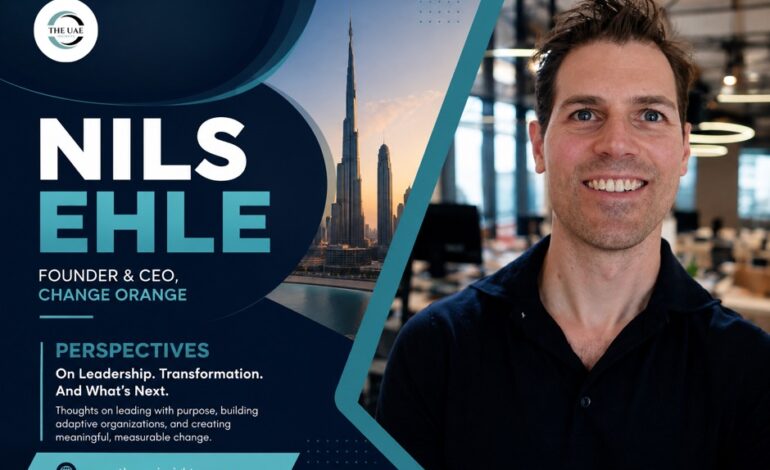
Across the UAE’s fast-growing AI landscape, one name keeps surfacing in conversations about what actually separates AI experiments from AI transformation that lasts: Nils Ehle. As Founder & CEO of Change Orange, Nils Ehle has spent two decades studying why business change succeeds or stalls, and his verdict on most current AI efforts is candid.
The Problem With Starting at the Use Case
“Many organizations get this part wrong at first, and it’s completely understandable,” Nils Ehle says. “The pressure to show AI progress is enormous, so leaders jump straight into use cases, chatbots, copilots, isolated proofs of concept, and months later wonder why nothing has scaled.” His argument is that AI business transformation is not a use-case sport but a capability-building exercise, one that requires groundwork most companies skip in their rush to demonstrate progress.
That thinking underpins Change Orange’s six-dimensional AI Business Maturity Model: data, technology infrastructure, organization and process, individual and team skills, the link between AI portfolio and business strategy, and leadership culture. Only two of the six, Nils Ehle points out, are actually about AI. “The other four are about core organizational strength,” he says. “AI is the current trigger. The capabilities you build are the lasting muscle.”
Two Decades Before Change Orange
Before founding his practice, Nils Ehle built his career at Accenture and then E.ON, moving from IT transformation into the operational sales side of the energy business. In 2012, he was given the freedom to set up an international transformation unit across 12 country markets, reporting directly to the board. That experience led him to help build a cross-company innovation hub in Germany’s Ruhr Valley, connecting roughly 80 organizations to match the right technology to the right business problem. Change Orange was founded in 2015 and today is fully focused on AI business transformation delivered in what Nils Ehle calls a human-first way.
That focus covers more ground than the maturity model alone suggests. Nils Ehle’s practice runs from AI strategy development through end-to-end AI business transformation, business model and operating model redesign, workforce capability building, and the change management that keeps a transformation from stalling once the strategy work is done. “Clients don’t come to us for a diagnosis and a slide deck,” Nils Ehle says. “They come to us to actually change how the business runs, and that means staying in the work from strategy through to the people on the ground.”
A Different Kind of Leadership Model
Nils Ehle argues that AI’s growing ability to absorb managerial tasks is forcing a genuine shift in what leadership means. “That’s a big shift, from the management of tasks to the leadership of people,” he says. His seven-dimensional leadership model spans willingness to learn, emotional intelligence, data and technology fluency, adaptability, systemic thinking, creativity, and courage to change, all of it, he insists, now core operating skills rather than soft extras.
He often illustrates the point with the elephant, whose heart weighs roughly five times more than its brain, unlike humans, where the ratio is reversed. “Most modern leadership is built on that imbalance, heavy on analysis, light on heart,” Nils Ehle says. “The leaders succeeding in this era are shifting deliberately toward heart-based leadership.”
What Local Businesses Get Right and Wrong
Speaking to the pressures facing organizations in fast-moving markets like the UAE, Nils Ehle is careful to separate genuine ambition from fear-driven cost cutting. “The engagements I lean into are the ones where I see a real spark, a spirit of wanting to do things themselves, not just a fear-driven push to cut costs with AI without any thought for the meaningful change it could drive for people,” he says.
He’s equally direct about agentic AI systems and AI-native companies now emerging across sectors. “AI should not be humanized,” Nils Ehle says. “It’s a powerful capability space that enhances human potential, and people remain responsible for the outcomes.” He points to MIT Media Lab research on cognitive debt as evidence that leaning too heavily on AI can quietly erode people’s own thinking. “The biggest risk is not AI itself. It’s humans giving up their own potential.”
A Product Built for Practical Roadmapping
Nils Ehle and his network partners have also built AI Use Case Engine, a real-time system that maps a company’s business capabilities and then proposes, benchmarks, and prioritizes AI and automation use cases against real-world examples. He describes it as pairing narrow artificial intelligence with human judgment, what he calls general human intuitive intelligence, deliberately kept in the loop rather than automated away.
The Mantra Worth Reconsidering
“Many organizations say AI first. I think that’s the wrong mantra,” Nils Ehle says. “The right mantra is people first, lived from the heart.” As efficiency becomes a commodity delivered by AI to nearly everyone, he argues that genuine service to people, customers, and employees alike, becomes the real differentiator between companies that merely function well and those that thrive.
Grounded, Not Balanced
Away from client engagements, Nils Ehle plays the handpan, runs, and spends time in nature with family, describing these not as breaks from his work but as part of how his best ideas arrive. “New ideas rarely arrive when you’re staring at the problem,” he says. “They arrive when you’ve stepped away.”
Nils Ehle speaks regularly on AI business readiness and leadership in a VUCA Plus world. More on his work at Change Orange is available at www.changeorange.com, with regular reflections shared on LinkedIn, X, YouTube, and TikTok.
Also Read:-
Kassem Lahham | From Deutsche Bank to Leading an Independent Wealth Advisory Firm in Dubai
Aubrey Heldt’s Vision on Excellence and Innovation in Corporate Travel